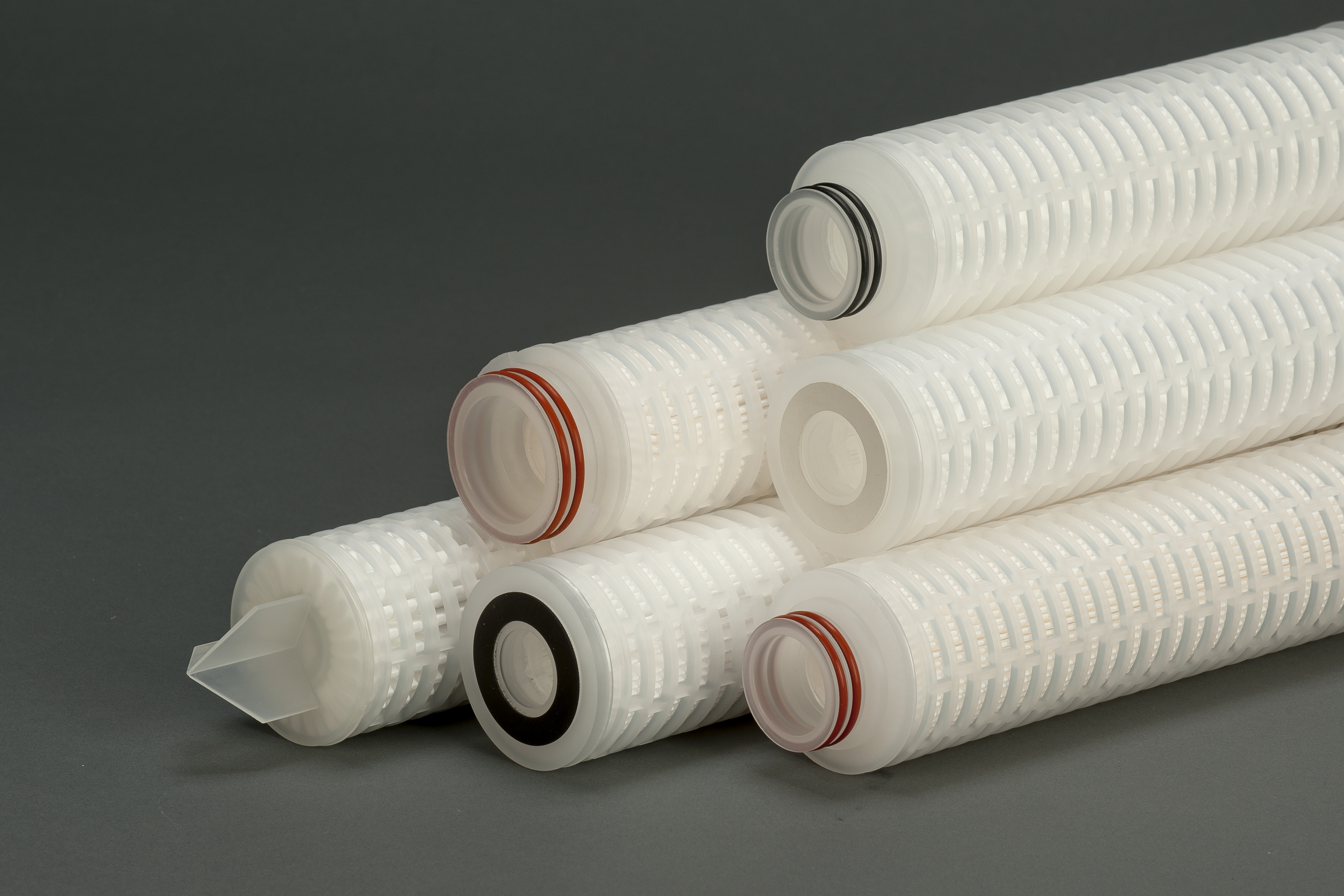



Membrane cartridge filters are a critical part of industrial and pharmaceutical process filtration systems, providing precise and repeatable particle, bacteria and microorganism removal. While membrane filters are often grouped together as a single category, the polymer chemistry of the membrane has a major influence on performance, compatibility and cost.
PES, PTFE, PVDF and Nylon Explained
This article explains the four most commonly used process filtration membrane materials – PES, PTFE, PVDF and Nylon – focusing on industrial applications, chemical compatibility and performance characteristics that drive membrane selection. The aim is to give practical, application-led guidance rather than purely theoretical comparisons.
What is a Membrane Filter?
A membrane filter is a surface filtration medium with a tightly controlled pore structure. Unlike depth filters, which trap contaminants throughout the media thickness, membranes retain particles primarily on the surface.
Key characteristics of membrane filters include:
- Defined pore size (e.g. 0.1, 0.2, 0.45 µm)
- High retention efficiency
- Low extractables when correctly selected
- Cleanability and integrity testability (in many designs)
The base polymer determines chemical resistance, wettability, temperature limits and suitability for different fluids.
PES (Polyethersulfone) Membrane Filters
Key Properties
- Naturally hydrophilic
- Very low protein binding
- Excellent flow rates
- Broad chemical compatibility
- Good thermal stability
Typical Applications
- Pharmaceutical process water (PW, WFI)
- Biopharmaceutical buffers and intermediates
- Food & beverage filtration (beer, wine, soft drinks)
- Cosmetics and personal care products
- Fine chemical filtration
Why PES is Used
PES has become one of the most widely used membrane materials in process filtration due to its combination of high flow rate and low adsorption.
Because PES is naturally hydrophilic, it:
- Does not require pre-wetting with solvents
- Is easy to flush and integrity test
- Minimises loss of valuable proteins or active ingredients
In pharmaceutical and bioprocessing applications, low protein binding is critical to avoid product loss and batch inconsistency. In food and beverage filtration, PES offers a good balance of microbial control, taste neutrality and long service life.
PES membranes are commonly supplied in asymmetrical structures, allowing high dirt-holding capacity while maintaining precise retention.
PTFE (Polytetrafluoroethylene) Membrane Filters
Key Properties
- Naturally hydrophobic
- Exceptional chemical resistance
- Resistant to aggressive solvents
- Wide temperature tolerance
- Very low extractables
Typical Applications
- Aggressive chemical filtration
- Solvent filtration (ketones, aromatics, hydrocarbons)
- Compressed air and gas filtration
- Vent filtration
- Acid and caustic solutions
Why PTFE is Used
PTFE is often selected when chemical compatibility is the overriding requirement. Few polymers can match PTFE’s resistance to strong solvents, oxidising chemicals and extreme pH conditions.
Because PTFE is hydrophobic, it is ideal for:
- Gas and air filtration, where water repellency is required
- Vent filters protecting tanks and vessels
For liquid filtration, PTFE membranes are usually supplied with a hydrophilic support layer or are pre-wetted with alcohol or other wetting agents before use.
In chemical processing and specialty manufacturing, PTFE membranes provide long service life and predictable performance in environments where other membrane materials would degrade or swell.
PVDF (Polyvinylidene Fluoride) Membrane Filters
Key Properties
- Available in hydrophilic and hydrophobic forms
- Good chemical resistance
- High mechanical strength
- Low extractables
- Excellent temperature stability
Typical Applications
- Pharmaceutical sterilising filtration
- Biotechnology and fermentation processes
- Food and beverage sterilising-grade filtration
- Diagnostic and life science applications
- Vent and gas filtration (hydrophobic grades)
Why PVDF is Used
PVDF is often chosen as a high-performance alternative to PES, particularly where additional mechanical strength or temperature resistance is required.
Hydrophilic PVDF membranes offer:
- Low protein binding
- Reliable bacterial retention at 0.2 µm
- Robust performance during steam or hot water sanitisation
Hydrophobic PVDF membranes are widely used for sterile air, gas and vent filtration, offering excellent water repellency while maintaining good airflow.
In pharmaceutical environments, PVDF is valued for its consistency, integrity test reliability and low extractables profile, making it suitable for validated processes.
Nylon (Polyamide) Membrane Filters
Key Properties
- Naturally hydrophilic
- Good mechanical strength
- Broad solvent compatibility
- Higher protein binding than PES or PVDF
- Cost-effective
Typical Applications
- General chemical filtration
- Solvent filtration
- Plating solutions
- Photoresists and electronics chemicals
- Laboratory filtration
Why Nylon is Used
Nylon membranes offer excellent chemical compatibility across a wide range of solvents, making them popular in chemical and industrial applications.
However, nylon has a higher affinity for proteins and biomolecules, which limits its use in pharmaceutical or bioprocess applications where product adsorption is unacceptable.
Where adsorption is not a concern, nylon provides:
- Reliable particle retention
- Good flow rates
- A cost-effective membrane solution
This makes nylon a common choice in electronics manufacturing, surface treatment processes and laboratory environments.
How to Choose the Right Membrane for Process Filtration
Selecting the correct membrane is not simply a matter of pore size. Key questions to consider include:
- Is the fluid aqueous or solvent-based?
- Is protein or active ingredient adsorption acceptable?
- What is the operating temperature and cleaning regime?
- Is the application liquid, gas or vent filtration?
- Are regulatory or validation requirements involved?
Summary Comparison
|
Membrane |
Wettability |
Key Strength |
Typical Sectors |
|
PES |
Hydrophilic |
High flow, low protein binding |
Pharma, F&B, cosmetics |
|
PTFE |
Hydrophobic |
Extreme chemical resistance |
Chemicals, solvents, gases |
|
PVDF |
Both |
Strength, sterilising reliability |
Pharma, biotech, vents |
|
Nylon |
Hydrophilic |
Solvent compatibility, cost |
Chemicals, electronics |
Frequently Asked Questions (FAQ) on Process Filtration Membranes
What is the best membrane filter for sterilising-grade filtration?
For most sterilising-grade (0.2 µm) liquid filtration applications, PES and hydrophilic PVDF membranes are the most commonly used. They offer low protein binding, high flow rates and reliable bacterial retention, making them suitable for pharmaceutical, bioprocessing and beverage applications.
Which membrane is best for solvent filtration?
PTFE and Nylon membranes are typically preferred for solvent filtration. PTFE offers the broadest chemical resistance and is ideal for aggressive or mixed solvents, while Nylon is often selected for less aggressive solvents where cost efficiency is important.
What membrane should be used for air and gas filtration?
Hydrophobic PTFE and hydrophobic PVDF membranes are widely used for air, gas and vent filtration. Their water-repellent properties prevent liquid penetration while maintaining high airflow and particulate retention.
Why is PES not suitable for aggressive chemical filtration?
While PES has good overall chemical compatibility, it is not resistant to some strong solvents and oxidising agents. In aggressive chemical environments, PTFE or Nylon membranes are usually better suited to avoid membrane degradation or swelling.
How does membrane material affect flow rate?
Flow rate is influenced by both membrane polymer and structure. Hydrophilic membranes such as PES and PVDF typically provide higher flow rates in aqueous applications, while hydrophobic membranes may require pre-wetting for liquid service to achieve optimal performance.
Conclusion: Selecting the Correct Membrane for Your Process
Membrane selection is about matching material properties to process demands. Using the wrong membrane can lead to poor flow, chemical attack, product loss or premature failure.
Understanding the differences between PES, PTFE, PVDF and Nylon allows engineers and operators to make informed decisions that improve process reliability, product quality and overall filtration cost of ownership.
If you have any questions on membrane filtration solutions or your process filtration system more generally, then give us a call or send us an email - we’d be more than happy to help.
You can also read more:
- Membrane Vs Depth Filtration in MicroFiltration: A Technical Comparison
- A Guide to Selecting the Right Micron Rating
- Process Cartridge Filters for Aggressive Chemical Filtration
- Membrane Cartridge Filters And The Options Available For Sterile & Final Filtration
- And you can browse our full range of Membrane Cartridge Filters here.
PoreFiltration – Making your filtration systems work harder