



 Water is essential to almost every manufacturing process, from cleaning and cooling to product preparation and equipment operation. Yet as pressure on water resources increases, businesses are being encouraged to consider how efficiently they use the water available to them.
For some manufacturers, water reuse could provide an opportunity to reduce reliance on incoming supplies, lower discharge volumes and improve overall resource efficiency.
But recovering water is only part of the challenge. It must also be treated to a suitable quality for its intended reuse.
Why is water efficiency becoming more important?
The latest Environment Agency water resources report highlights the increasing pressure on England's water supplies.
National water demand reached 14,110 million litres per day in 2025–26, compared with 13,946 million litres per day in the previous year. This was also higher than the forecast of 13,774 million litres per day.
The report highlights the importance of reducing demand, improving water efficiency and developing more resilient supplies.
For manufacturers, this reinforces the value of understanding where water is being used, where it is being discharged and whether suitable streams could be treated for another application.
Where can filtration support water reuse?
Different industries will have different opportunities, but filtration can form an important part of a wider water-treatment process.
1. Process and wash water
Water used for equipment cleaning, washing and general manufacturing operations may offer opportunities for recovery, depending on its contamination profile and the intended reuse.
Bag and cartridge filters can help remove suspended solids before water moves into further treatment or a suitable non-product-contact application.
2. Cooling-water systems
Cooling systems can require significant volumes of make-up water. Filtration can help manage suspended solids within circulating water, while additional treatment may be needed to control dissolved minerals, corrosion and biological growth.
In some applications, further treatment of suitable wastewater or blowdown streams may allow water to be recovered for reuse.
3. Reverse osmosis and water treatment
Where higher-quality water is required, reverse osmosis (RO) can form part of a wider treatment strategy.
However, RO membranes need suitable feed-water conditions. Effective prefiltration can help reduce suspended particles and protect downstream membranes from particulate fouling.
Choosing the right filtration approach
There is no universal water-reuse solution. The correct treatment depends on the water source, contaminants present and the quality required at the point of reuse.
Filtration options may include:
- Bag filters: Suitable for removing suspended solids, particularly where contaminant loading is higher.
- Cartridge filters: Available in different materials and filtration ratings to provide more controlled particulate removal.
- Activated carbon: Can help reduce certain dissolved organic compounds, depending on water chemistry and treatment objectives.
- Membrane filtration: Can provide finer separation where required.
- RO prefiltration: Helps protect reverse osmosis membranes from particulate contamination.
It is important to remember that filtration does not remove every type of contaminant. Dissolved chemicals and microbiological risks may require additional treatment, testing and monitoring.
Start by understanding your water
Before investing in a new filtration system, businesses should consider how much water is being used, what contaminants are present and whether the recovered water can realistically meet the requirements of another process.
A well-designed approach could help reduce unnecessary water consumption while protecting equipment and maintaining consistent process quality.
The takeaway: Water reuse is not simply about recovering more water. It is about treating the right water to the right standard for the right application.
PoreFiltration can help assess particulate-filtration requirements and identify suitable bag, cartridge and membrane options for wider water-treatment systems.
Looking to improve water efficiency? Speak to PoreFiltration about your process and filtration requirements.
Information reference: Environment Agency, Water Resources 2025–2026, published October 2026.
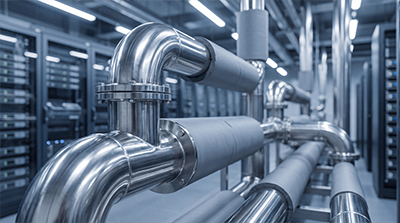 As demand for cloud computing, artificial intelligence and digital services continues to grow, data centres are becoming increasingly important to modern infrastructure.
Behind every data centre is a substantial cooling requirement. Servers generate heat during operation, and maintaining suitable temperatures is essential to protecting equipment and supporting reliable performance.
This creates an important role for water management and filtration.
Why is cooling becoming such a major consideration?
A March 2026 briefing from the UK Parliamentary Office of Science and Technology estimated that data centres account for around 2% of UK electricity consumption, with approximately one-third of their energy use going towards cooling.
As computing demand grows, maintaining efficient cooling systems becomes increasingly important.
Water use is also receiving greater attention. A government statement in October 2026 estimated that data centres currently account for less than 0.2% of non-household water consumption in England. However, it highlighted the importance of managing future demand, particularly in areas already experiencing water stress.
This means cooling systems need to balance reliability, energy efficiency and responsible water use.
Where does filtration fit in?
Particulate contamination can enter cooling-water systems through make-up water, installation debris, corrosion products and other sources.
If left unmanaged, suspended solids can contribute to fouling, blocked components and additional maintenance.
Several filtration approaches can help manage these risks.
1. Side-stream filtration
Rather than filtering the entire circulating flow, side-stream filtration treats a proportion of the water before returning it to the system.
This can help reduce suspended solids over time and manage particulate contamination within suitable cooling circuits.
2. Make-up water filtration
Incoming water can introduce particles into cooling systems. Bag and cartridge filters can help remove suspended solids before water enters the circuit or further treatment stages.
3. Equipment protection
Strainers and suitable cartridge filters can help protect pumps, valves, heat exchangers and other components from unwanted debris.
Selecting the right filter
The correct filtration solution depends on the cooling-system design, water quality and equipment being protected.
Important considerations include:
- Micron rating: What particle size needs to be removed?
- Flow rate: Can the filter handle the required operating flow?
- Differential pressure: How much pressure drop can the system tolerate?
- Filter life: How frequently will elements need replacing?
- Material compatibility: Are the filter media and seals suitable for the water and any treatment chemicals?
A finer filter is not automatically a better choice. If the specification is unnecessarily restrictive, it could increase pressure drop and maintenance requirements.
Filtration should also be considered alongside wider water-treatment measures. It does not replace chemical treatment, corrosion control, scale management or microbiological monitoring where these are required.
Looking beyond the filter itself
For data-centre operators, the aim is to maintain reliable cooling while managing operating costs and resource consumption.
Monitoring differential pressure, filter replacement frequency and water quality can help identify changes in contamination levels and highlight opportunities to improve the filtration setup.
As cooling infrastructure evolves, reviewing filtration requirements can help ensure that systems remain suitable for their operating conditions.
The takeaway: Reliable cooling depends on more than temperature control. Managing particulate contamination is an important part of protecting the equipment that keeps data centres running.
PoreFiltration supplies bag filters, cartridge filters, strainers and filtration solutions for industrial water and cooling applications.
Reviewing your cooling-water filtration? Contact PoreFiltration to discuss your application.
Information references: UK Parliamentary Office of Science and Technology, What are data centres and how sustainable are they?, March 2026; UK Government, Data-centre water and energy statement, October 2026.