



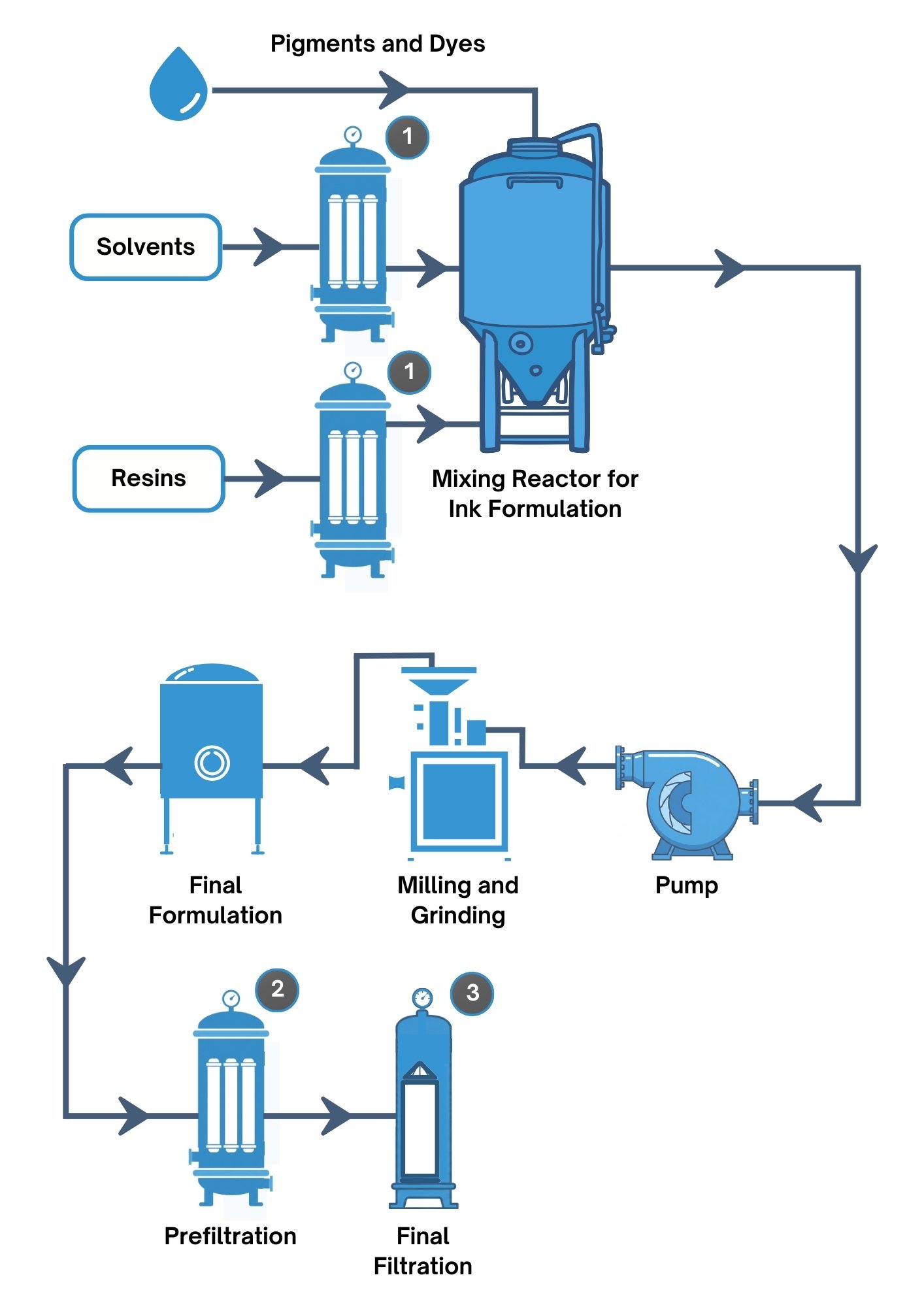
Filtration Solutions for Digital Ink Manufacturing
Filtration Steps in Digital Ink Manufacture

Initial Process Protection
The process begins with the controlled addition of raw materials:
- Solvents act as the carrier fluid
- Resins provide adhesion and film formation
- Pigments & dyes deliver colour and optical properties
These materials are introduced into a mixing reactor, where initial blending takes place to form a crude ink formulation.
At this early stage, coarse contamination control is critical. Any foreign particles, agglomerates, or inconsistent raw material solids can negatively impact downstream milling and dispersion.
Recommended Products:
Solvents - PurePore Pleated Polypropylene Depth Filter - 5-10 Micron
Resin - PurePore Depth Filter - 5-10 Micron
Industrial Housing
Bulk Particle Reduction
After initial mixing, the ink is pumped through milling and grinding equipment, where pigment particles are broken down into much finer dispersions.
This is one of the most critical stages in ink production.
After milling, the ink still contains:
- Residual agglomerates
- Oversized pigment particles
- Undispersed solids
- Wear particles from equipment
This stage removes bulk contamination before final refinement, protecting downstream final filters.
Recommended Products:
PurePore Pleated Polypropylene Depth Filter - 5-10 Micron
PurePore Depth Filter - 5-10 Micron
Industrial Housing
Final Filtration
The final stage is the most critical for print quality.
Here, the ink passes through fine filtration systems designed to ensure absolute consistency before packaging or delivery to printing systems.
Final filtration delivers:
- Smooth, stable ink suitable for high-resolution printing
- Consistent particle distribution
- Reliable printhead performance
- Extended equipment life
Typical technologies include fine cartridge filtration or membrane-based systems, depending on the ink chemistry and required resolution.
Recommended Products:
- SurePore Absolute pleated polypropylene cartridges
- PES membrane cartridges
- PTFE membrane cartridges (for some solvent applications)
- Hygienic Housing
Digital ink manufacturing demands exceptional levels of cleanliness, consistency, and process control to ensure reliable printer performance and high-quality image reproduction. Across inkjet technologies, contaminants such as oversized pigments, gels, agglomerates, microorganisms, and airborne particles can lead to blocked printheads, inconsistent jetting, reduced print quality, and costly operational downtime. Filtration plays a critical role throughout the production process, from raw material preparation and dispersion through to final filling and packaging. As digital printing technologies continue to advance across graphics, textiles, packaging, ceramics, and industrial applications, high-performance filtration systems are essential for maintaining ink stability, protecting print systems, and ensuring repeatable production quality across every batch.
Speak to an Expert
+44(0) 203 750 8060
Drop Us an Email
enquiries@porefiltration.co.uk
Digital Ink Filtration Resources and Support
Why is filtration important in digital ink manufacturing?
Filtration removes contaminants that can block printheads, reduce print quality, and cause printer downtime. Clean, stable ink is essential for consistent jetting performance and image quality.
What contaminants are typically removed from digital inks?
Common contaminants include oversized pigments, agglomerates, gels, microorganisms, carbon fines, and airborne particles introduced during manufacture or handling.
Do different ink chemistries require different filtration approaches?
Yes—pigmented, solvent-based, aqueous, dye-based, and UV-curable inks each present unique filtration challenges requiring different filter media and micron ratings.
What micron ratings are commonly used in digital ink filtration?
Typical filtration ranges from coarse prefiltration down to 0.2 micron membrane filtration, depending on ink chemistry and printhead sensitivity.
Can filtration improve printer uptime and reduce maintenance?
Yes—effective filtration prevents nozzle blockage and reduces contamination-related downtime, helping maintain continuous printer operation and reducing maintenance costs.
Digital Ink Blogs:
-
Filtering Digital Inks: Common Pain Points Across All Formulation types
-
The Key Challenges for Filtration in Digital Ink Manufacture.
Read some of our most popular blogs on Industrial filtration:
- Improving Coating Quality: How Paint Filtration Prevents Nozzle Blockages and Inconsistent Finishes
- Choosing the Right Bag Filter Material for Chemical Compatibility
- The Smarter Route to Chemical Compatibility in Filter Housings
- Process Cartridge Filters for Aggressive Chemical Filtration
- Understanding Inline Filters in Process Applications
- Filtering Digital Inks: Common Pain Points Across All Formulation types
Pigmented
Often multiple stages of filtration are required after initial mixing to form the dispersion and again after additive addition and dilution. It is necessary to ensure removal of particulates, contaminates and oversized or agglomerates pigments from the dispersion. Depth and pleated depth filters are used.
Solvent based
We need to ensure the removal of undissolved and oversized particulate, but we have the added complication of potential chemical compatibility issues caused by MEK. Pleated depth
Dye based
Key here is the dyes are free of particulate and all organic contaminants otherwise undissolved dye components, gels or bacteria may cause issue at the printer. Typically, pleated depth filters for particulate, gels, etc and membranes used to remove bacteria, although there is discussion currently that all applications could use pleated depth filters if careful selection is made. This is a more economical solution for end users if appropriate due to initial filter and life span.
UV curable
The challenges are far different because additionally to the normal range of contaminates UV curable inks see gel formation during the production process and gels are variable in size and deformable making them difficult to remove. For this reason, depth filters are used because of their depth of filtration media.
The process of manufacturing digital inks consists of three stages (Resin process, manufacturing process and packaging). Each benefit from using cartridge filtration to prevent introduction into the process via raw materials (particulate, bacteria) and removal of potential contaminants created within the process (haze, gels). Similarly deionised water and additives used during the process need treating with similar care.
Removing Gels from UV Curable Inks
UV curable inks can develop gels during manufacture, storage and handling, creating a significant challenge for filtration. Unlike hard particles, gels are often soft and deformable, making them difficult to remove using conventional surface filtration. ClearPore depth filters utilise a multi-layer depth structure that captures gels throughout the filter media, providing effective removal while maintaining flow rates and service life. This helps protect printheads, improve ink consistency and reduce costly print defects.
When MEK Compatibility is Critical
Solvent-based inks frequently contain aggressive solvents such as Methyl Ethyl Ketone (MEK), requiring filtration solutions that offer both effective particle retention and excellent chemical compatibility. PurePore pleated depth filters are specifically designed to withstand demanding solvent environments while removing undissolved solids, oversized particles and process contamination. Their high surface area and depth filtration construction provide long service life, reliable performance and protection for downstream equipment.
Reducing Change-Out Time When Changing Inks
Frequent colour changes and short production runs can result in significant downtime during filter replacement. The CleanQuik filtration system is designed to simplify cartridge change-outs, allowing operators to replace filters quickly and safely while minimising exposure to inks and solvents. By reducing maintenance time, product loss and operator handling, CleanQuik helps improve production efficiency and maximise line uptime in digital ink manufacturing environments.
Commitment to quality is of paramount importance at PoreFiltration. We supply filtration solutions that help customers

protect their processes, meet regulatory requirements, and deliver consistent, high-quality finished products across industrial, food & beverage, chemical, and water applications. As such we have been certified to ISO9001, providing a quality management system that covers the entire organization for clarity and transparency in our processes.
Our Quality Commitment
Every PoreFiltration product is supplied with one clear objective: to perform reliably, consistently, and exactly as intended.
We are committed to:
- Meeting customer, regulatory, and application-specific requirements
- Supplying filtration products with consistent, repeatable performance
- Providing clear specifications, traceability, and technical guidance
- Continually improving our products, processes, and quality systems
If you need any more information on any aspect of quality management and assurance, then give us a call or send us an email - we’d be more than happy to help.
Clean-In-Place (CIP) and Sterilise-In-Place (SIP) systems are critical to maintaining hygiene, product safety, and regulatory compliance in food, beverage, dairy, and pharmaceutical processing.
CIP enables the cleaning of pipelines, vessel
s, filters, and process equipment without dismantling, using controlled cycles of detergents, temperature, and flow to remove product residues, biofilms, and contaminants.
SIP follows with high-temperature steam sterilisation to eliminate microorganisms and ensure systems are safe for production.
Effective CIP/SIP design ensures:
- Reliable microbial control
- Reduced downtime and manual intervention
- Protection of filtration systems and membranes
- Consistent product quality and audit readiness
When properly engineered, CIP and SIP are not just cleaning steps they are integral to process performance and operational efficiency.
Read more in our blog: How CIP & SIP Can Extend Cartridge Filter Lifespan.
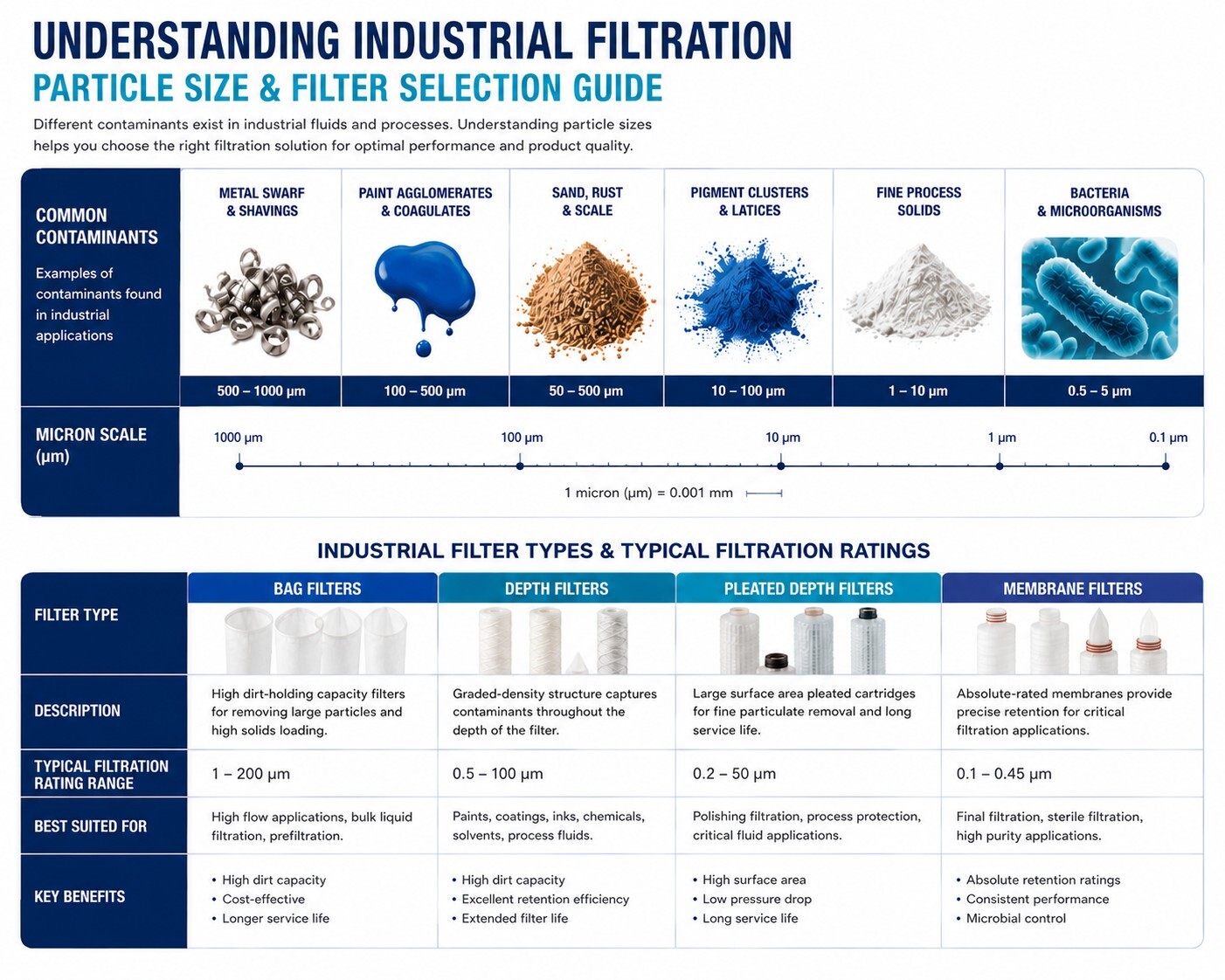
The Role of Cartridge Filtration in Digital Ink Manufacturing
In digital ink production, cartridge filtration provides a critical control point for maintaining ink cleanliness, protecting printheads, and ensuring product consistency. Throughout the manufacturing process, filtration systems remove particulates, gels, agglomerates, and process contaminants that could otherwise compromise ink performance or damage sensitive printing equipment. Different filtration technologies—including depth, pleated depth, and membrane filters—are used depending on the ink chemistry and stage of production.
Across digital ink manufacturing, cartridge filtration supports three key objectives:
- Protection of printheads and jetting performance: Removes contaminants that can cause nozzle blockage, poor jetting consistency, and print defects
- Maintaining ink stability and product quality: Ensures inks remain free from agglomerates, gels, and oversized particles that affect image quality
- Supporting efficient and repeatable manufacturing processes: Provides controlled filtration across raw material preparation, blending, polishing, and final packaging
Because digital ink formulations vary significantly, filtration strategies must be tailored to each application. Pigmented inks often require staged depth filtration to manage particle size distribution, while UV-curable inks present additional challenges due to deformable gel formation during production. Solvent-based inks also require careful filter material selection to ensure chemical compatibility with aggressive solvents such as MEK. By integrating correctly specified cartridge filtration systems, digital ink manufacturers can improve process reliability, reduce waste, and maintain consistent print performance across increasingly demanding applications.
Each digital ink chemistry presents distinct filtration challenges. Pigmented inks contain dispersed solid particles that must remain tightly controlled to prevent printhead blockage, while dye-based inks require removal of dissolved contaminants and microbial growth. UV-curable inks are particularly challenging due to gel formation during processing, with deformable contaminants requiring depth filtration rather than conventional surface filtration. Solvent-based inks introduce additional chemical compatibility demands, particularly where aggressive carriers such as MEK are used. As a result, filtration systems must be carefully matched to the rheology, chemistry, and particle profile of each formulation.
Modern inkjet printheads operate with extremely fine nozzle geometries, making them highly sensitive to particulate contamination. Oversized pigments, agglomerates, crystalline particles, and gels can obstruct nozzles and disrupt droplet formation, leading to banding, inconsistent colour density, and printer downtime. Because printheads can represent a major operational cost, filtration is often viewed not simply as a process step, but as a critical asset protection strategy. Many manufacturers implement staged filtration approaches to progressively remove larger contaminants before final polishing filtration near the filling or printer supply stage.
Digital ink processes commonly use a combination of depth and membrane filtration technologies. Depth filters provide high dirt-holding capacity and are highly effective at removing gels, agglomerates, and irregular particles generated during milling or dispersion processes. Membrane filters offer tighter and more absolute particle control, making them suitable for final polishing stages and sensitive aqueous formulations. In many applications, combining staged depth and membrane filtration delivers the best balance between contaminant retention, flow rate, and filter service life.
One of the biggest challenges in digital ink filtration is balancing fine particle retention with acceptable flow rates and filter life. Filtration that is too coarse increases the risk of particle breakthrough and printhead blockage, while excessively fine filtration can lead to rapid blockage, reduced throughput, and increased consumable costs. Optimising filtration therefore requires detailed understanding of particle size distribution, viscosity, and process conditions rather than relying solely on nominal micron ratings. Staged filtration trains are commonly used to improve efficiency while maintaining operational productivity.
Many digital inks contain aggressive solvents, surfactants, and additives that can affect filter integrity if unsuitable materials are used. PTFE, polypropylene, nylon, and PVDF are commonly selected depending on solvent chemistry, operating temperature, and process exposure conditions. In solvent-heavy systems, chemical compatibility testing is often required to ensure filters maintain structural integrity and do not introduce extractables that could affect ink stability or print performance.
Filtration plays a major role in maintaining repeatable batch quality across large-scale digital ink production. By controlling particulate levels and removing process-generated contamination, filtration helps manufacturers achieve consistent colour performance, viscosity stability, and shelf life across batches. Effective filtration also reduces waste, minimises rejected product, and supports faster production turnaround by preventing contamination-related process interruptions. As digital printing standards continue to rise, filtration has become an increasingly important part of process optimisation and quality assurance strategies.

Talk to us today about your filtration requirements
-
Extensive product range
-
Best Price GUARANTEED!
-
Specialist support team with deep knowledge of liquid & gas applications
-
Reliable quality & delivery

