


In paint and coatings manufacturing, some of the most expensive production problems start with some of the smallest particles.
A blocked spray nozzle might seem like a minor inconvenience. After all, replacing or cleaning a nozzle only takes a few minutes. But for manufacturers operating high-volume production lines, the true cost extends far beyond the nozzle itself.
Production interruptions, inconsistent coating application, increased paint consumption, product defects, equipment maintenance, and rejected finishes can all be traced back to one common issue: particulate contamination.
While coatings technology continues to advance, spray nozzle blockages remain one of the most persistent challenges facing manufacturers across automotive, industrial, aerospace, marine, packaging, and architectural coatings sectors.
The question is not whether contamination exists within the process.
The question is whether your filtration strategy is removing it before it reaches the spray system.
Why Spray Nozzle Blockages Remain So Common
Modern paint and coating formulations are becoming increasingly sophisticated. 
Manufacturers are developing coatings with enhanced durability, improved aesthetics, faster curing times, corrosion resistance, chemical protection, and environmental compliance. Water-based coatings, low-VOC formulations, UV-cured systems, and high-performance protective coatings all require greater precision than ever before.
However, as formulations become more advanced, they also become more sensitive to contamination.
Even microscopic particles can interfere with application equipment and affect the final finish.
Many manufacturers focus heavily on formulation quality and application performance but underestimate the role contamination plays throughout the manufacturing process.
By the time a spray nozzle becomes blocked, the contamination has often travelled through multiple stages of production undetected.
The blockage itself is usually just the final symptom of a much larger contamination control issue.
Where Does the Contamination Come From?
Contaminants can enter a coatings process at virtually any stage of manufacturing.
Common sources include: 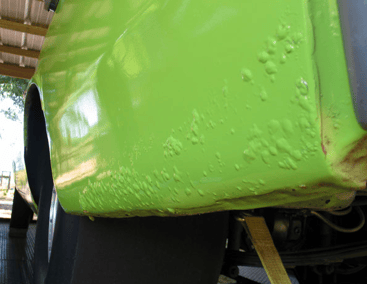
- Coagulated pigments
- Gel particles
- Resin agglomerates
- Dust contamination
- Fibres
- Tank residues
- Process debris
- Metal particles from equipment wear
- Cross-batch contamination
- Raw material impurities
Many of these particles are invisible to the naked eye but large enough to create problems within spray equipment.
As coatings move through mixing vessels, storage tanks, transfer lines and filling systems, contamination can accumulate throughout the process.
Without effective filtration, these particles eventually reach the application stage where they can disrupt spray performance and impact product quality.
The Hidden Cost of a Blocked Spray Nozzle
Most manufacturers recognise nozzle blockage as a maintenance issue.
In reality, it is often a productivity issue, a quality issue, and a profitability issue.
Reduced Throughput
When spray equipment becomes blocked, production slows down.
Operators must stop the process to inspect, clean or replace nozzles before restarting production.
While a single interruption may seem insignificant, repeated stoppages can create substantial losses in output over time.
For high-volume manufacturing environments, even small interruptions can have a measurable impact on production efficiency.
Inconsistent Finish Quality
A partially blocked nozzle can be just as problematic as a completely blocked one.
Restricted flow can create:
- Uneven coating thickness
- Poor atomisation
- Surface defects
- Streaking
- Inconsistent coverage
- Reduced gloss performance
These defects often become visible only after application, creating costly rework and quality control challenges.
Increased Paint Consumption
When spray patterns become inconsistent, operators often compensate by increasing paint usage.
Poor atomisation and inefficient application can lead to:
- Overspray
- Excess coating application
- Higher material consumption
- Increased waste
Over time, even marginal increases in paint usage can significantly affect operating costs.
Higher Maintenance Requirements
Frequent nozzle cleaning and replacement places additional strain on maintenance teams.
Repeated blockages can lead to:
- Increased labour costs
- Greater equipment downtime
- Additional spare parts consumption
- Reduced operational efficiency
The issue becomes even more significant in facilities operating multiple spray lines or automated coating systems.
Why Filtration Often Falls Short
Many filtration systems currently operating in paint manufacturing facilities were designed around older coating technologies and production requirements.
Historically, filtration was often treated as a final-stage quality control step, installed immediately before application.
While this approach may remove some contaminants, it often allows particles to circulate throughout the process before being captured.
By this point, contamination may already have:
- Accumulated within storage systems
- Damaged equipment
- Contributed to product instability
- Increased the risk of downstream blockages
Traditional surface filtration systems can also struggle when dealing with high contaminant loads.
Because particles accumulate primarily on the filter surface, flow restriction can increase rapidly, resulting in:
- Shorter service life
- More frequent filter changes
- Increased maintenance
- Higher operating costs
As coating formulations become more complex, manufacturers increasingly require filtration systems capable of delivering greater contaminant retention while maintaining process efficiency.
Best Practices for Reducing Spray Nozzle Blockages
The most effective manufacturers no longer view filtration as a final checkpoint.
Instead, they treat contamination control as a process-wide strategy.
Several best practices can significantly reduce the risk of spray nozzle blockages.
Filter Throughout the Process
Contamination should be removed as early as possible. 
Implementing filtration at multiple stages helps prevent particles from travelling through the production system and causing downstream issues.
This may include filtration during:
- Raw material transfer
- Mixing operations
- Tank filling
- Product transfer
- Final application
Match Filtration to the Formulation
Different coatings have different filtration requirements.
A filtration strategy suitable for one formulation may not deliver optimal results for another.
Selecting the correct filtration media and micron rating is critical to balancing contamination removal with process performance.
Monitor Filter Performance
Waiting until filters become blocked or fail can lead to unnecessary downtime.
Regular monitoring and proactive replacement schedules help maintain consistent filtration efficiency while protecting production equipment.
Focus on Root Cause Prevention
Nozzle blockages should not be viewed as isolated maintenance issues.
Repeated blockages often indicate broader contamination challenges within the manufacturing process.
Addressing contamination at its source delivers longer-term operational improvements.
How PoreFiltration Helps Paint Manufacturers Reduce Nozzle Blockages
At PoreFiltration, we work with paint and coatings manufacturers to improve contamination control throughout the production process.
Our filtration solutions are designed to remove the particles that contribute to spray nozzle blockage while supporting product quality and operational efficiency.
ClearPore Depth Filtration
ClearPore depth filtration captures contaminants throughout the filter structure rather than only on the surface.
This provides:
- High dirt-holding capacity
- Excellent particle retention
- Extended service life
- Consistent filtration performance
The result is cleaner coatings and reduced risk of application-related contamination issues.
CleanPore Bag Filtration
CleanPore bag filtration systems provide reliable removal of particulate contamination while maintaining efficient process flow.
Benefits include:
- Reduced nozzle blockage
- Improved coating consistency
- Lower maintenance requirements
- Reduced downtime
- Greater production reliability
A Complete Contamination Control Strategy
The most effective filtration strategy extends beyond a single filter housing or application point.
By implementing contamination control throughout the production process, manufacturers can reduce defects, improve equipment performance and minimise costly disruptions.
Turning a Small Problem into a Competitive Advantage
Spray nozzle blockages may appear to be a minor operational issue, but their impact can be substantial.
Lost production time, increased maintenance, inconsistent finishes and excess paint consumption all reduce profitability and place additional pressure on manufacturing operations.
As coatings become more advanced and customer expectations continue to rise, manufacturers can no longer afford to treat contamination as an afterthought.
The companies achieving the highest levels of quality and efficiency are those taking a proactive approach to filtration and contamination control.
Because when it comes to paint and coatings manufacturing, preventing a blockage is always less expensive than dealing with the consequences.
To learn more about how PoreFiltration helps manufacturers reduce contamination and improve coating performance, contact our team today - give us a call or send us an email - we’d be more than happy to help.
And here are a few more blogs and links that you might find useful:
- Porefiltration’s range of Depth Filters & Bag Filters
- Why Cartridge Filters Block Too Quickly: 7 Common Reasons
- Understanding Inline Filters in Process Industries
- What Issues Cause You to Consider Changing Filtration System
PoreFiltration – Making your filtration systems work harder