



 When selecting a filter for a chemical application, the first question is often whether the filter material is "chemically resistant". While this is important, compatibility is rarely quite that simple. The performance of a filter can depend on the chemical itself, concentration, operating temperature, exposure time and the construction of the filter. A material that performs well with a particular chemical at room temperature may behave differently when the same chemical is concentrated or heated.
This is particularly important when replacing an existing filter. A like-for-like replacement may have the correct dimensions and micron rating but still be unsuitable if the material or construction differs. Chemical attack can cause filter media to swell, soften, become brittle or lose mechanical strength, potentially resulting in premature failure or contamination. In a process where filtration is protecting a final product or critical piece of equipment, that can quickly become much more expensive than the original filter.
For example, polypropylene is widely used because it offers good resistance to many acids, alkalis and aqueous process fluids, making it a versatile option across industrial applications. However, that doesn't mean polypropylene is suitable for every chemical process. Depending on the chemistry and temperature, materials such as PTFE, polyester or nylon may provide a more appropriate solution.
Compatibility should therefore be considered alongside the rest of the filtration specification rather than treated as a separate check. When reviewing a chemical application, we would typically want to understand the fluid being filtered, concentration, temperature, flow rate, expected service life and whether the filter will be exposed to cleaning chemicals.
The important question isn't simply "Will this filter work?" — it's "Will this filter continue to perform reliably under our actual process conditions?"
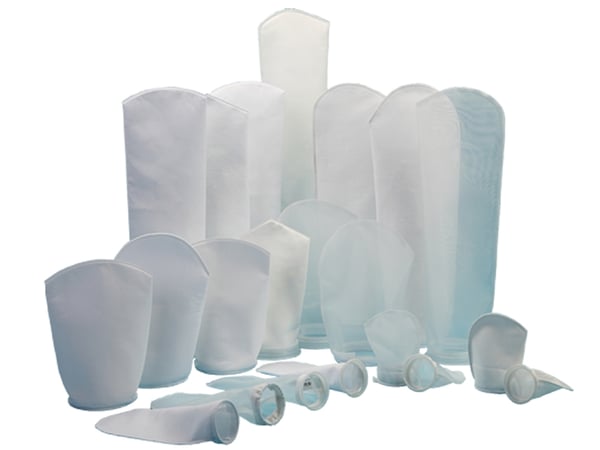 Bag filters are often treated as a relatively simple filtration product, but the choice of material can have a significant effect on how the filter performs. Polypropylene, polyester, nylon, Nomex and PTFE each have different characteristics, meaning the best choice depends on what you're filtering and the conditions the filter will experience.
Polypropylene needlefelt is a popular general-purpose option, particularly across water, food and beverage and many industrial applications. It offers good chemical resistance and is often selected where cost-effective depth filtration is required. Polyester can be useful where higher temperature capability is required, while nylon provides good mechanical strength and is commonly used where a durable filtration material is needed. For more demanding chemical or temperature environments, PTFE can offer a significantly higher level of chemical resistance.
The application itself should also influence whether you choose needlefelt or mesh. Needlefelt is a depth filtration media, meaning particles become trapped throughout the thickness of the material. This makes it particularly useful where there is a relatively high contaminant load and dirt-holding capacity is important. Mesh, by comparison, provides surface filtration and can offer a more defined particle separation, making it useful for applications where repeatable particle retention and easy cleaning or recovery are priorities.
As a general guide, bag material selection can look something like this:
|
Material |
Common Areas of Use |
|
Polypropylene |
Water, food & beverage, general chemicals |
|
Polyester |
Industrial liquids, higher-temperature applications |
|
Nylon |
Industrial processing, mesh filtration, stronger mechanical applications |
|
Nomex |
Higher-temperature industrial applications |
|
PTFE |
Aggressive chemicals, solvents and demanding applications |
These aren't hard rules. Chemical compatibility, temperature, pressure, micron rating and process conditions should always be checked before specifying a filter.
The key takeaway is that the "right bag" isn't necessarily the one that matches the previous specification. It's the one that is appropriate for the actual application.
 MYTH
MYTH
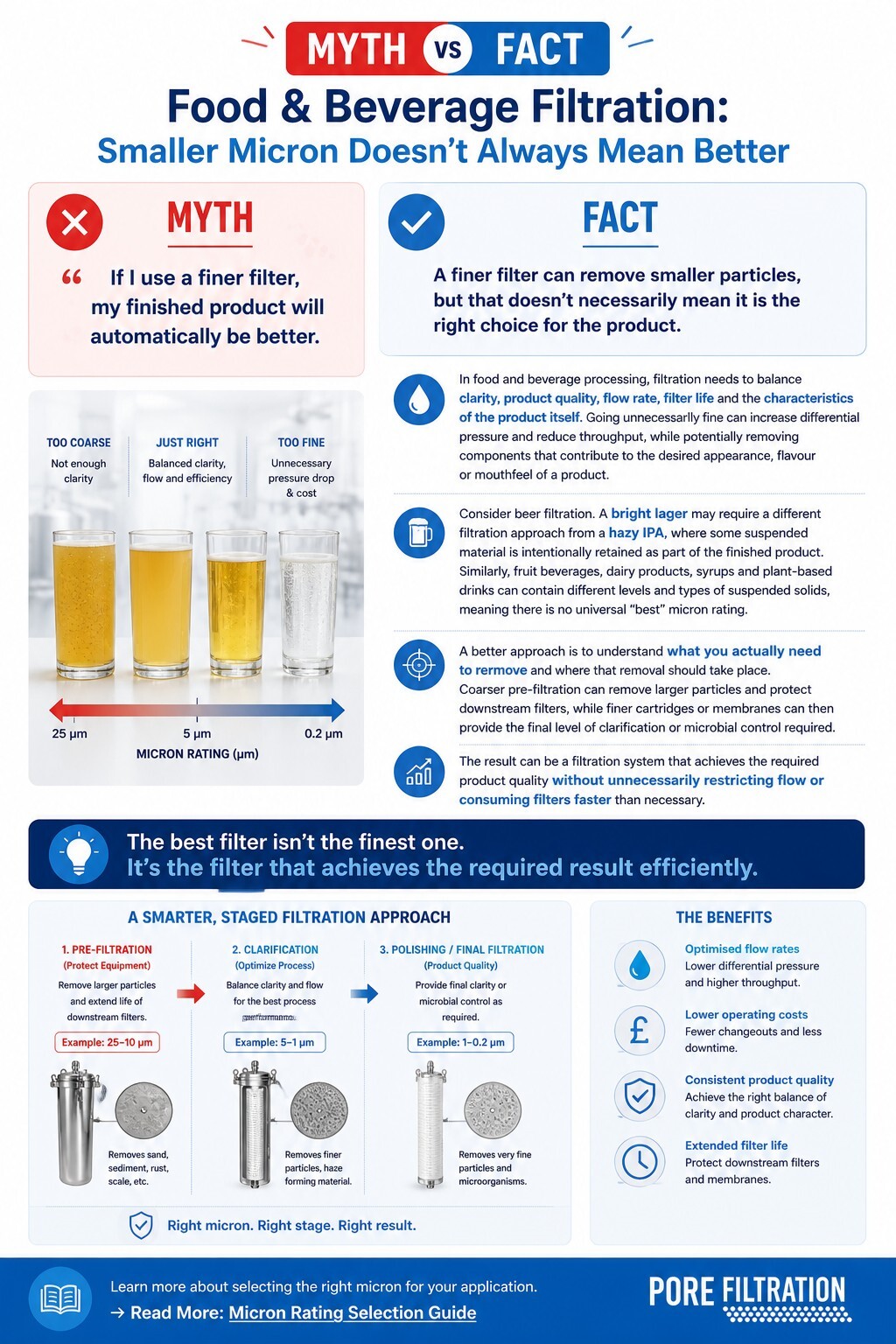
"If I use a finer filter, my finished product will automatically be better."
FACT…
A finer filter can remove smaller particles, but that doesn't necessarily mean it is the right choice for the product.
In food and beverage processing, filtration needs to balance clarity, product quality, flow rate, filter life and the characteristics of the product itself. Going unnecessarily fine can increase differential pressure and reduce throughput, while potentially removing components that contribute to the desired appearance, flavour or mouthfeel of a product.
Consider beer filtration. A bright lager may require a different filtration approach from a hazy IPA, where some suspended material is intentionally retained as part of the finished product. Similarly, fruit beverages, dairy products, syrups and plant-based drinks can contain different levels and types of suspended solids, meaning there is no universal "best" micron rating.
A better approach is to understand what you actually need to remove and where that removal should take place. Coarser pre-filtration can remove larger particles and protect downstream filters, while finer cartridges or membranes can then provide the final level of clarification or microbial control required.
The result can be a filtration system that achieves the required product quality without unnecessarily restricting flow or consuming filters faster than necessary.
The best filter isn't the finest one. It's the filter that achieves the required result efficiently.
Download Myth vs Fact Info Graphic
 When a membrane cartridge starts blocking earlier than expected, the natural reaction is often to blame the filter. But premature blockage can actually tell you something important about the process upstream of the membrane.
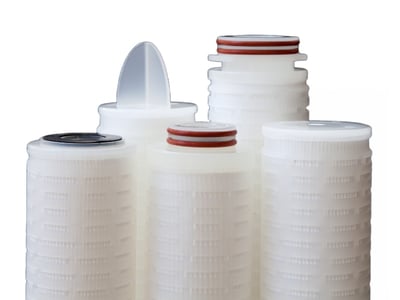
Membrane filters are designed to provide fine filtration, which means they can be particularly sensitive to the amount of particulate they receive. If excessive solids, colloids or other contaminants reach the membrane, the available filtration area can become loaded quickly. Differential pressure then rises, flow falls and the cartridge reaches its changeout point sooner than expected.
This is why looking at the membrane in isolation can sometimes lead to the wrong solution. Increasing the micron rating might improve filter life, but it could also compromise the level of filtration required. Equally, simply fitting a larger or more expensive membrane may mask the underlying issue rather than solve it.
A more effective approach is to look at the complete filtration train. Is the pre-filter removing enough particulate? Has the feed composition changed? Is the process generating more contamination than expected? Has the operating flow rate increased? Is the selected membrane material appropriate for the product?
For example, if a beverage producer is seeing a final membrane block after only a few days, the answer may not be to change the final membrane at all. Improving the upstream depth filtration could reduce the contaminant load reaching the membrane and extend its service life significantly.
A membrane filter's lifespan is often determined by what happens before the membrane ever sees the product.