



5 micron doesn't always mean the same thing.
Understanding the difference between nominal and absolute filtration can help you choose the right filter for your process — rather than simply choosing the smallest micron rating available.
When selecting a filter cartridge, it's common to start with the micron rating.
You might specify a 5 micron filter, for example, and assume that any 5 micron filter from another supplier will provide broadly the same level of filtration.
But there is an important question behind that specification:
Is it a 5 micron nominal filter or a 5 micron absolute filter?
The difference can have a significant impact on what your filter actually removes, how quickly it loads, and how it performs within the wider filtration system.
Importantly, neither nominal nor absolute filtration is automatically the better option. The right choice depends on what you are trying to achieve.
What Does a Micron Rating Actually Tell You?
A micron (µm) rating describes the size of particles a filter is designed to retain.
But the micron rating on its own doesn't tell you how efficiently the filter removes particles of that size.
Consider two filters:
-
5 micron nominal
-
5 micron absolute
Both are labelled 5 micron, but their actual particle removal performance can be very different.
This is why simply specifying a micron rating can sometimes lead to confusion when comparing products or changing suppliers.
What Is a Nominal Filter?
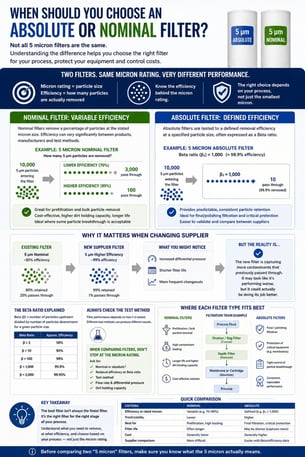
A nominal filter provides a level of particle removal at its stated micron rating, but the percentage of particles removed can vary considerably depending on the filter construction, manufacturer and test method.
For example, two nominal 5 micron filters could have noticeably different removal efficiencies at 5 microns.
As an illustration, imagine a process containing 10,000 particles around 5 microns in size.
If one filter removes 70% of those particles, approximately:
7,000 particles are retained
while around:
3,000 particles pass through.
A different nominal filter might remove 99% under its specified test conditions, retaining approximately 9,900 particles.
The important point is not that every nominal filter falls between 70% and 99% — it doesn't. Nominal ratings can cover a broad range of efficiencies depending on the manufacturer and test method.
So when specifying a nominal filter, the micron rating alone doesn't necessarily tell you the whole story.
 Why Choose a Nominal Filter?
This is where nominal filtration can actually be a very positive choice.
A nominal filter isn't necessarily an inferior version of an absolute filter.
For many applications, you may not need extremely high particle retention.
Nominal filters can be a practical and cost-effective option where:
-
The filtration is being used for prefiltration or protection
-
The downstream equipment can tolerate some particle passage
-
The process has a relatively high contaminant load
-
Maximising filter life is important
-
You want to remove the majority of larger particles without excessive restriction
-
A highly defined particle retention isn't required
-
The filter is part of a multi-stage filtration system
For example, using a nominal filter as the first stage of filtration can remove a significant amount of particulate before the fluid reaches a finer downstream filter.
That can help protect the finer filter and potentially extend its service life.
Nominal filtration can therefore be about finding the right balance.
You don't necessarily want every filter in a system to have the highest possible retention.
If a coarse or nominal filter can effectively handle the bulk of the contaminant loading, it may make more sense to use it upstream and reserve a higher-efficiency filter for where it is actually required.
What Is an Absolute Filter?
An absolute-rated filter is intended to provide a much more clearly defined and reproducible level of particle retention at a specified particle size.
However, there is an important technical point here:
“Absolute” is not, by itself, a universal industry standard.
Different manufacturers can use the terminology differently, which is why it is better to look for a defined efficiency or Beta ratio when comparing filters.
For example:
β5 ≥ 1000
means that the filter has a Beta ratio of at least 1,000 at 5 microns.
The Beta ratio is calculated by comparing the number of particles upstream of the filter with the number downstream.
A Beta ratio of 1,000 corresponds to approximately 99.9% efficiency at that particle size.
So, theoretically, for every 1,000 particles of the specified size entering the filter, around 999 are retained and 1 passes through.
This gives you much more useful information than simply saying:
“5 micron filter.”
Why Choose an Absolute Filter?
Absolute filtration becomes particularly useful when predictable and defined particle retention is important.
For example:
-
Protecting sensitive downstream equipment
-
Protecting membrane systems
-
Final or polishing filtration
-
Applications where particle breakthrough needs to be tightly controlled
-
Processes where consistent filtration performance is important
-
Applications where the customer needs to specify and verify a particular removal performance
An absolute filter can make the filtration requirement easier to communicate.
Instead of telling a supplier:
“We need a 5 micron filter.”
You can specify something closer to:
“We need a 5 micron filter with a defined minimum removal efficiency.”
Or, where appropriate:
“5 micron, β5 ≥ 1000.”
That gives both the customer and supplier a much clearer performance target.
 Why This Matters When Changing Suppliers
This is one of the areas where the difference between nominal and absolute filtration can become particularly important.
Imagine a customer has historically used a 5 micron nominal filter.
They change supplier and purchase another 5 micron filter.
On paper, the filters appear identical.
But the new filter may have a significantly higher removal efficiency.
The customer then notices that the new filter:
-
Loads more quickly
-
Experiences a faster increase in differential pressure
-
Needs changing more frequently
They may conclude:
“The new filter isn't as good.”
But that isn't necessarily the case.
The new filter could actually be retaining more of the contaminant that the previous filter allowed through.
The customer hasn't necessarily bought a worse filter.
They may have changed the filtration performance of the process without realising it.
A Simple Example
Imagine a process has 10,000 particles around the 5 micron range.
Existing nominal filter.
If the existing filter removes approximately 80%:
-
8,000 particles retained
-
2,000 particles pass through
Replacement filter.
If the replacement filter removes 99%:
-
9,900 particles retained
-
100 particles pass through
The replacement filter is removing considerably more contamination.
But because it is capturing more material, it may also load faster.
That means a shorter filter life doesn't automatically mean poorer performance.
It could indicate that the replacement filter is doing more work.
Of course, that doesn't automatically make the replacement suitable either. If the process was designed around the previous filter's capacity, the higher-efficiency filter may require changes to the upstream filtration, surface area, flow rate or changeout strategy.
This is why filter replacement should be treated as a process decision, not simply a product swap.
Is Absolute Always Better?
No.
This is an important distinction.
If your process genuinely requires highly defined particle retention, an absolute filter may be the appropriate choice.
But if you're using filtration for bulk particulate removal or prefiltration, an absolute filter could provide more retention than you actually need.
That can potentially mean:
-
Faster loading
-
Higher differential pressure
-
Shorter service life
-
More frequent changeouts
-
Higher consumable costs
A well-designed filtration system often uses different levels of filtration at different stages.
For example:
Bulk contamination → Nominal/coarse filtration → Finer filtration → Absolute/final filtration
The objective isn't to make every stage as fine as possible.
The objective is to make the overall filtration process work efficiently.
Nominal vs Absolute: Which Should You Choose?
|
Consideration |
Nominal |
Absolute |
|
Particle retention |
Broad/variable depending on specification |
More clearly defined at a specified particle size |
|
Prefiltration |
✓ Often suitable |
✓ Can be used |
|
High contaminant loading |
✓ Often advantageous |
Can load more quickly |
|
Final/polishing filtration |
Application dependent |
✓ Often preferred where defined retention is required |
|
Predictable retention |
Less defined unless additional performance data is provided |
✓ More clearly defined |
|
Supplier comparison |
Can be difficult from micron rating alone |
Easier when supported by efficiency/Beta data |
|
Cost optimisation |
✓ Can be advantageous |
May cost more depending on specification |
|
Best choice |
Depends on process |
Depends on process |
For more information and a guide about selecting the correct micron rating - View Now
Don't Compare Filters by Micron Rating Alone
When comparing filters — particularly when changing suppliers — don't stop at:
“Is it 5 micron?”
Ask:
1. Is the rating nominal or absolute?
This establishes the basic filtration classification.
2. What is the actual removal efficiency?
A percentage at a defined particle size gives you much more information than the micron rating alone.
3. What is the Beta ratio?
Where available, Beta ratio provides a useful way of comparing particle retention performance.
4. What test method was used?
The way filtration performance is measured matters when comparing products.
5. What is the contaminant loading?
A filter with higher retention may capture more contamination and therefore load faster.
6. What flow rate and differential pressure are expected?
Filtration performance and filter life are influenced by the wider operating conditions.
7. What is the filter's role in the system?
A prefilter doesn't necessarily need the same retention performance as a final filter.
The Right Filter Is About More Than “Smaller Micron = Better”
It's tempting to think:
1 micron must be better than 5 micron.
And:
absolute must be better than nominal.
But filtration doesn't work that simply.
A finer or higher-efficiency filter can remove more particles — but that doesn't mean it is automatically the best choice for every stage of a process.
The best filter is the one that provides the right level of particle removal for that particular application, while delivering acceptable flow, differential pressure, service life and operating cost.
Sometimes that means a nominal filter.
Sometimes it means an absolute filter.
And quite often, it means using both.
The Takeaway
When choosing between nominal and absolute filtration, the question shouldn't simply be:
“Which one is better?”
It should be:
“What level of particle retention does my process actually require?”
Nominal filters can provide an effective and economical way of handling particulate loading, particularly in prefiltration and protection stages.
Absolute filters can provide more defined and predictable particle retention where tighter control is required.
And when comparing products from different suppliers, the most useful specification isn't simply:
“5 micron.”
It's a specification that tells you what 5 micron actually means - including the required removal efficiency or Beta ratio, test method and operating conditions.
Because choosing the right filter isn't about choosing the finest filter. It's about choosing the right filter for the job.
Download the Guide Absolute Vs Nominal
PoreFiltration – Making your filtration systems work harder

/collage-email.jpg)