


Time, throughput and differential pressure explained and why the pressure drop across your filter can tell you far more about its remaining life.
When should you change a filter cartridge?
For many operations, the answer is simple:
"We change them every month."
It's easy to manage, easy to plan and provides a consistent maintenance routine.
But there is a problem.
The calendar doesn't know how hard your filter has been working.
A filter operating continuously at a high flow rate and contaminant loading is going to experience very different conditions from one operating intermittently.
There are three common ways to determine when a filter should be replaced:
- Time
- Volume/throughput
- Differential pressure
All have their uses, but they aren't equally precise.

1. Time-Based Replacement — Simple, But Unprecise
The simplest method is to replace the filter after a fixed period.
For example:
"Replace the cartridge every 30 days."
This can work well where the process is extremely consistent and the filter's historical performance is predictable.
The problem is that two filters can be installed for 30 days but process completely different amounts of fluid.
Example
A filter operating 8 hours per day might process 20,000 litres in a month.
The same filter operating 24/7 could process 60,000 litres.
Both reach their changeout date on the same day.
The filter hasn't necessarily experienced the same workload.
Time-based replacement is therefore convenient, but it tells you very little about the actual condition of the filter.
2. Volume-Based Replacement — More Useful, But Still Limited
A more useful approach is to monitor how much fluid the filter has processed.
Instead of:
"Change every 30 days."
you might establish:
"Change after approximately 50,000 litres."
This accounts for differences in operating time and production levels.
Example: Establishing a Filter Capacity
Imagine a process using a depth filter cartridge that has historically processed approximately 50,000 litres before reaching its normal changeout condition.
If the process runs at:
5,000 litres/hour
the cartridge would theoretically provide around:
10 hours of operation
before reaching that established capacity.
If the process then increases to:
10,000 litres/hour
the same 50,000-litre volume is processed in only:
5 hours.
The filter hasn't changed.
The workload has.
However, there is still a significant limitation:
50,000 litres of clean water isn't the same as 50,000 litres of heavily contaminated water.
If the contaminant loading doubles, the filter could reach its changeout condition after processing considerably less than 50,000 litres.
For example, a filter that normally processes 50,000 litres might only manage 25,000–30,000 litres during a period of significantly higher particulate loading.
This is why throughput should be viewed as a useful operating indicator rather than a guaranteed filter capacity.
Actual filter capacity should always be established from the specific application and manufacturer's performance data.

3. Differential Pressure — The Most Useful Indicator
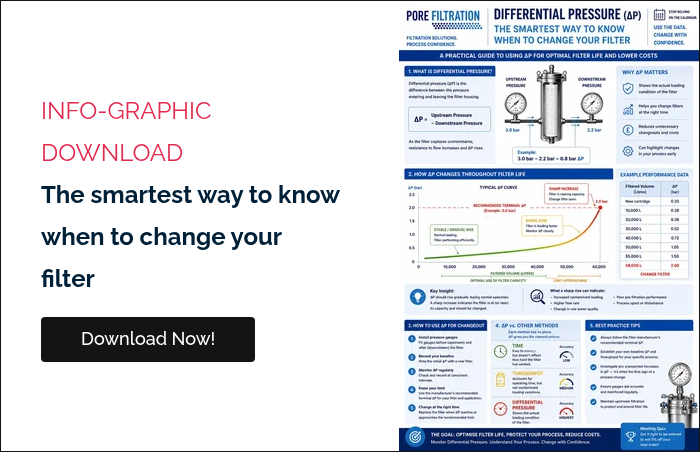
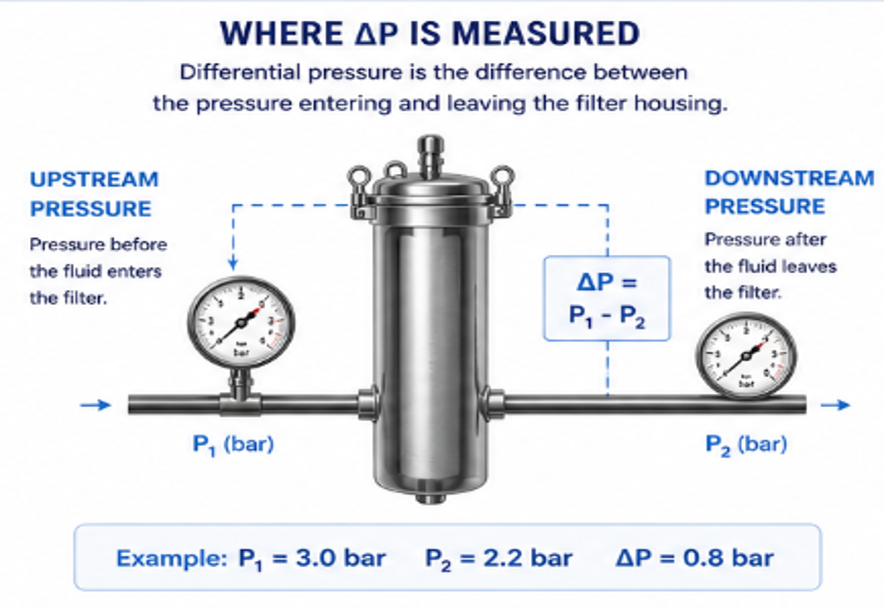
Where it is practical to monitor it, differential pressure (ΔP) provides a much more direct indication of how heavily a filter is being loaded.
Differential pressure is the difference between the pressure entering and leaving the filter:
ΔP = Upstream Pressure − Downstream Pressure
For example:
Upstream: 3.0 bar
Downstream: 2.2 bar
Therefore:
ΔP = 0.8 bar
As the filter captures contaminants, resistance to flow generally increases.
This causes the differential pressure across the cartridge to rise.
That means you're no longer estimating filter life based on how long the filter has been installed or how much fluid has passed through it.
You're monitoring how the filter is actually performing.
What Does Differential Pressure Tell You?
Imagine a new filter starts with a differential pressure of:
0.2 bar
As the process runs:
0.2 → 0.3 → 0.4 → 0.6 → 0.8 → 1.0 bar
The increasing pressure drop indicates that the filter is progressively loading with contaminants.
Eventually, the filter reaches the manufacturer's recommended terminal differential pressure.
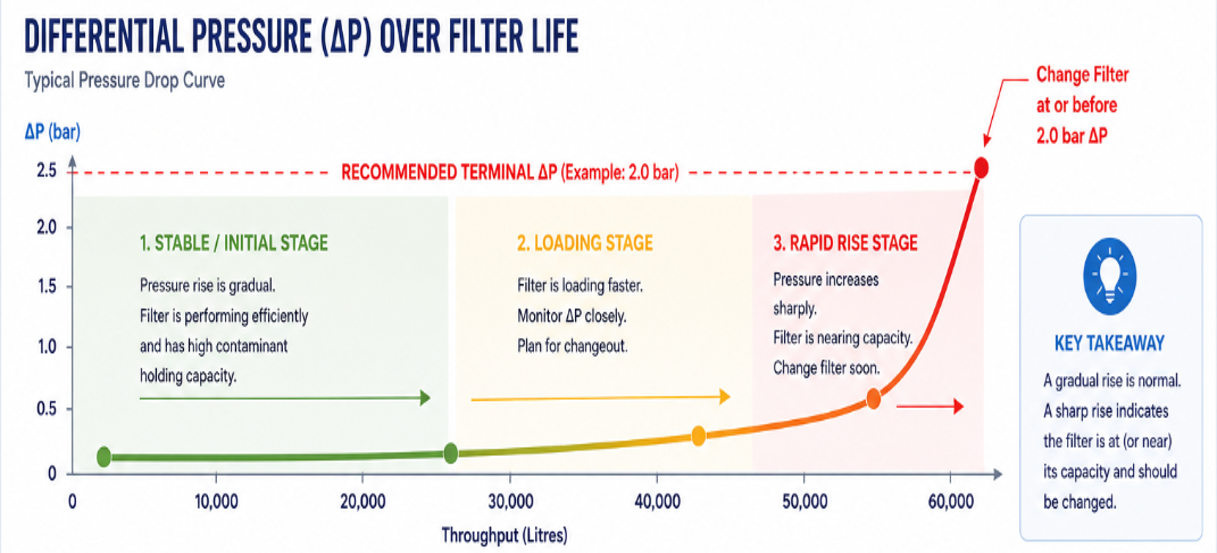
At this point, the cartridge should be replaced in accordance with the relevant technical specification.
Example: Using Differential Pressure to Determine Changeout
Imagine a cartridge manufacturer specifies a recommended terminal differential pressure of 2.0 bar for a particular application.
A customer monitors the filter and records:
|
Operating point |
Differential pressure |
|
New cartridge |
0.2 bar |
|
10,000 L |
0.4 bar |
|
20,000 L |
0.7 bar |
|
30,000 L |
1.0 bar |
|
40,000 L |
1.4 bar |
|
50,000 L |
1.8 bar |
|
55,000 L |
2.0 bar |
The filter has therefore processed approximately 55,000 litres before reaching the chosen changeout point.
Now imagine the next cartridge reaches 2.0 bar after only 35,000 litres.
That is valuable information.
The filter hasn't suddenly become "bad".
Something has changed.
The customer can investigate whether there has been:
- Increased contaminant loading
- Higher flow
- A change in raw water quality
- A process upset
- Reduced upstream filtration performance
This is one of the major advantages of differential pressure monitoring.
It doesn't just tell you when the filter is loaded it can help you identify changes in the process.
Important: The 2.0 bar value and volumes above are illustrative only. The appropriate terminal differential pressure must always come from the relevant filter manufacturer's specification and the requirements of the application.

Why Differential Pressure Is More Informative
Consider two identical cartridges.
Filter A
After processing 50,000 litres:
ΔP = 0.6 bar
Filter B
After processing 50,000 litres:
ΔP = 1.8 bar
Both have processed exactly the same volume.
But Filter B is much more heavily loaded.
If you were relying solely on throughput, both filters might appear to have reached the same point in their service life.
Differential pressure provides the missing information.
It tells you how the filter is responding to what it has processed.
Other Factors That Affect Filter Life
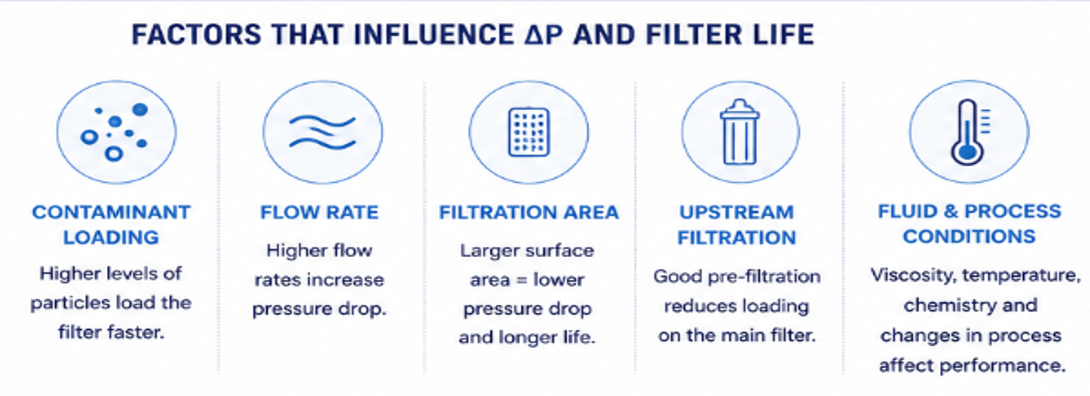
Filter life isn't determined by time, volume or differential pressure alone.
The conditions of the process can have a major influence on how quickly a cartridge reaches its changeout point.
Contaminant Loading
Perhaps the biggest factor is simply how much material the filter needs to remove.
Higher levels of suspended solids, particles, biological material, oils or other contaminants can consume filter capacity much faster.
A sudden change in incoming water quality can therefore result in a dramatic reduction in cartridge life.
Flow Rate
Higher flow rates can increase pressure drop and may result in faster loading.
For example, a cartridge operating at 5 m³/h may perform very differently from the same cartridge operating at 10 m³/h
This is why filter sizing needs to consider the actual process flow rather than simply selecting a cartridge based on dimensions and micron rating.
Filter Surface Area
Two cartridges with the same micron rating can have very different capacities if they have different effective filtration areas.
Increasing the number of cartridges or moving to a larger cartridge configuration can distribute the contaminant load across more media.
This can potentially extend service life and reduce pressure drop.
Upstream Filtration
The condition of the filtration stages before the cartridge can have a major impact.
If a bag filter or depth filter isn't effectively removing the intended contaminant loading, more material reaches the downstream cartridge.
For membrane filters in particular, effective prefiltration can be critical to achieving the expected service life.
Fluid Characteristics
The fluid itself matters.
Viscosity, temperature, particle size and particle characteristics can all influence filtration performance.
A filter designed for one process fluid shouldn't automatically be assumed to perform identically with another.
Cleaning and Process Conditions
Where CIP or SIP forms part of the process, the cleaning chemicals and temperatures should also be considered when selecting filter media.
Changes to cleaning procedures can affect:
- Filter compatibility
- Filter integrity
- Residual contaminants
- Downstream loading
Cleaning chemicals can also potentially become a contaminant source if residues or loosened deposits aren't adequately removed before the process returns to normal operation.

Which Method Should You Use?
The three approaches can be thought of as a progression:
|
Method |
Accuracy |
Main benefit |
|
Time |
Low |
Simple and easy to manage |
|
Throughput |
Medium |
Reflects how much fluid has been processed |
|
Differential pressure |
Highest* |
Shows the actual loading condition of the filter |
*Where differential pressure is an appropriate and reliable changeout criterion for the application.
This doesn't mean time and throughput are useless.
They can still be extremely valuable for maintenance planning, stock management and establishing historical filter performance.
But where differential pressure can be monitored and the filter manufacturer's specifications allow it to be used as a changeout criterion, it generally provides the most meaningful indication of filter loading.
The Best Approach? Use the Data Together
In practice, the most effective approach can be to use all three.
Time gives you a maintenance schedule.
Throughput tells you how much fluid the cartridge has processed.
Differential pressure tells you how the cartridge is actually responding to the load.
For example, if a filter normally reaches its recommended terminal ΔP after approximately 50,000 litres and 30 days, you now have a useful operating baseline.
If it suddenly reaches that pressure after only 30,000 litres, that's a reason to investigate.
Something may have changed.
And that's where filter monitoring becomes more than simply deciding when to replace a cartridge.
It becomes a way of understanding the filtration process itself.
Stop Asking "How Old Is the Filter?"
A filter doesn't necessarily need replacing because it has been installed for a certain number of days.
It needs replacing when it has reached the appropriate limit for the application.
For some processes, that may be a validated time interval.
For others, throughput may provide a useful indication.
But where practical, differential pressure provides a much clearer picture of how heavily the filter has actually been loaded.
So rather than asking:
"How long has this filter been installed?"
ask:
"What is the filter telling us?"
Monitoring differential pressure, alongside throughput and historical operating data, can help customers optimise filter life, reduce unnecessary cartridge changes and identify changes in the process before they become larger problems.
The calendar is easy. The data is better.