



3 Applications Where Water Filtration Matters
As data centres become more power-dense, cooling systems are under increasing pressure. Filtration plays an important role in protecting cooling infrastructure, controlling particulate build-up and maintaining water quality.
Data centres are becoming increasingly dependent on sophisticated cooling systems.
As computing density increases — particularly with AI and high-performance computing — managing heat effectively is becoming just as important as managing power.
That means the water circulating through cooling systems needs to be considered carefully.
Particles, corrosion products, scale and other contaminants can accumulate within cooling loops and equipment. Left unmanaged, these can contribute to blocked components, fouled heat exchangers, increased pressure drop and reduced cooling performance.
Filtration is therefore not simply about making the water “clean”.
It is about protecting the cooling system and maintaining reliable operation.
There are several points within a data centre's water infrastructure where filtration can play a role. Here are three key applications to consider.
1. Closed-Loop Cooling & Side-Stream Filtration
Closed-loop cooling systems circulate the same water repeatedly around the system.
This can provide a controlled environment for cooling, but it also means that contaminants introduced into the loop can continue circulating unless they are removed.
Potential sources of contamination can include:
-
Corrosion products
-
Pipework debris
-
Installation debris
-
Particles introduced during maintenance
-
Scale or precipitated material
-
General particulate contamination
This is where side-stream filtration can be useful.
Rather than filtering the entire system flow, a proportion of the cooling water is continuously or periodically diverted through a filtration system before being returned to the loop.
Why use side-stream filtration?
The objective isn't necessarily to remove every particle in a single pass.
Instead, the system gradually reduces the contaminant concentration within the loop.
A typical arrangement could include:
Cooling loop → side-stream take-off → particulate filtration → return to loop
Depending on the application, this could involve bag filtration, depth cartridge filtration or finer cartridge filtration.
The appropriate filtration level depends on the condition of the water and what the system needs to protect.
Why does this matter?
Maintaining cleaner circulating water can help reduce the amount of particulate reaching sensitive components and heat-transfer surfaces.
For a data centre operator, that can mean filtration becomes part of a wider strategy for:
Protecting equipment → maintaining heat transfer → controlling maintenance → supporting cooling reliability
The key consideration is not simply choosing the finest possible filter.
A side-stream system needs to balance particle removal, flow rate, filter life, pressure drop and operating cost.
2. Direct-to-Chip & Liquid Cooling
One of the biggest changes in data centre cooling is the increasing use of liquid cooling.
Instead of relying entirely on air to remove heat from servers, liquid can be brought much closer to the heat source.
Direct-to-chip cooling is one example.
Cooling fluid is circulated through cold plates or other heat-transfer components associated with the server hardware. The heat is then transferred away through the liquid cooling system.
This creates another important filtration consideration.
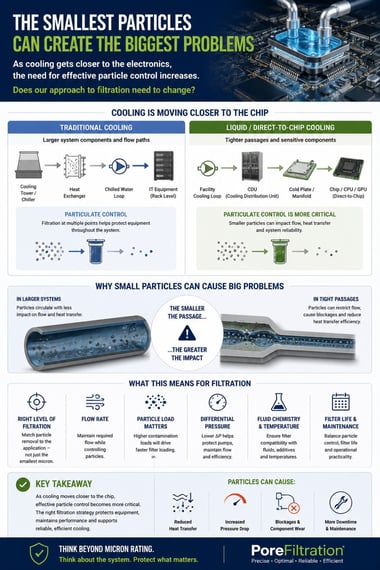
Small particles can become a big problem
Liquid cooling systems can contain relatively small passages and sensitive components.
That means particulate contamination can become increasingly important.
The filtration requirement therefore isn't necessarily the same as that of a traditional cooling-water system.
Depending on the system design, filtration may be required around areas such as:
-
Cooling Distribution Units (CDUs)
-
Secondary cooling loops
-
Cold-plate circuits
-
Heat exchangers
-
Pumps and associated components
The objective is to control particulate without unnecessarily restricting flow.
Filtration becomes part of the cooling design
This is where simply asking for a “5 micron filter” may not be enough.
The filtration requirement needs to consider:
-
Required particle retention
-
Flow rate
-
Differential pressure
-
Fluid chemistry
-
Temperature
-
Filter surface area
-
Contaminant loading
-
Required service life
A higher-efficiency filter may provide greater particle removal, but it can also capture more contamination and therefore load more quickly.
That doesn't necessarily mean it is a worse filter.
It means the filtration system needs to be designed around the actual cooling application.
For high-density computing environments, where cooling performance and equipment availability are critical, filtration should be considered as part of the liquid cooling system rather than an afterthought.
3. Chilled Water & Cooling Tower Systems
Not every data centre relies on direct-to-chip liquid cooling.
Many facilities continue to use chilled-water systems, cooling towers and associated HVAC infrastructure to remove heat from the building and IT environment.
These systems can involve significant volumes of water and complex circulation arrangements.
Filtration can be used at several points depending on the system design.
Chilled-water systems
Chilled-water loops can experience particulate contamination from corrosion, pipework and maintenance activity.
Filtration can therefore be used to help protect:
-
Chillers
-
Heat exchangers
-
Pumps
-
Control valves
-
Cooling coils
-
Other components within the circulation system
Again, side-stream filtration can be a practical approach where continuous full-flow filtration isn't necessary or economical.
Cooling towers
Cooling towers present a different filtration challenge because they are exposed to the environment and involve water evaporation and concentration.
As water evaporates, dissolved and suspended contaminants can become increasingly concentrated.
Filtration can therefore form part of a wider cooling-tower water management strategy.
Depending on the system, this can include filtration of:
Make-up water → circulating water → side-stream flow
The filtration requirement will depend heavily on the source water, cooling system design and water treatment programme.
The goal isn't simply to filter everything as finely as possible.
It is to control the contaminants that could contribute to fouling, scaling or equipment problems while maintaining an efficient system.
One Data Centre, Multiple Filtration Requirements
An important point is that there isn't one “data centre filter”.
A modern facility can have several different water systems operating alongside each other.
For example:
Incoming / make-up water
↓
Water treatment / prefiltration
↓
Cooling tower or chilled-water system
↓
Heat exchanger
↓
Secondary cooling loop
↓
Liquid cooling / CDU
↓
IT equipment
Each stage can have different filtration requirements.
A filter protecting a cooling tower does not necessarily need the same specification as a filter protecting a liquid cooling circuit.
Likewise, a filter selected for high contaminant loading may not be appropriate for a sensitive final cooling loop.
This is why filtration should be considered in relation to the whole cooling system.
 What Should You Consider When Selecting Data Centre Filters?
Before specifying a filter, it is worth looking beyond the micron rating.
Flow rate
How much water needs to pass through the filter?
Contaminant loading
What is actually causing the filtration requirement?
Corrosion products, installation debris, suspended solids and other contaminants can behave very differently.
Required particle retention
Does the system need coarse particulate removal, fine filtration or tightly controlled particle retention?
Differential pressure
How much pressure drop can the system tolerate?
Filter life
How frequently can filters realistically be changed?
Water chemistry
Is the filtration system compatible with the water chemistry and any treatment chemicals being used?
Equipment being protected
Is the filter protecting a pump, heat exchanger, chiller, cooling tower, CDU or sensitive liquid-cooling equipment?
These questions can have a much bigger impact on the right filter than simply choosing the smallest available micron rating.
Filtration Should Support Cooling Reliability
As data centre cooling systems become more sophisticated, filtration becomes increasingly important.
But the answer isn't necessarily:
“Use a finer filter.”
It is:
“Understand what the cooling system needs the filter to do.”
For closed-loop systems, side-stream filtration can help control particulate within circulating water.
For direct-to-chip and other liquid-cooling systems, filtration can help protect sensitive components and control particulate within the cooling circuit.
For chilled-water and cooling-tower systems, filtration can support equipment protection and wider water-management strategies.
In each case, the filtration requirement is different.
The right filtration solution starts with understanding the cooling application, the water and the equipment being protected.
At PoreFiltration, we can help assess the filtration requirement across cooling-water and liquid-cooling applications, from replacement cartridges and bags through to filtration-system considerations.
If you're reviewing filtration within a data centre cooling system, start with the process — not just the filter.
Download the Data Centre Cooling Filtration Guide
PoreFiltration – Making your filtration systems work harder


/collage-email.jpg)