



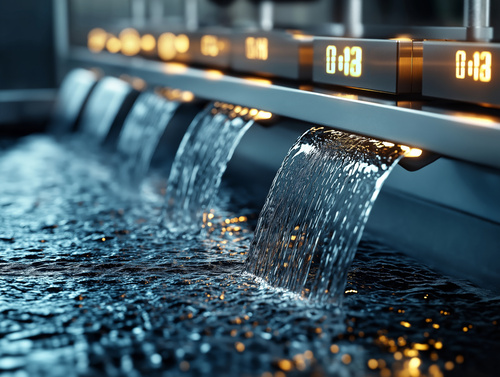
 Water is becoming an increasingly important production consideration for food and beverage manufacturers.
It's not simply about reducing the amount of water used.
The bigger question is becoming:
Can water that would previously have been discharged be treated and safely reused somewhere else in the process?
Recent European work has been looking directly at this challenge. The EU-backed AccelWater project investigated water recovery and reuse across food and beverage applications, combining technologies including clarification, membrane filtration, reverse osmosis, polishing, disinfection and biological treatment.
Its reported demonstrations achieved up to 95% water recovery and 93% wastewater reuse, alongside improvements in overall water and resource efficiency.
Meanwhile, the US EPA's 2026 Water Reuse Action Plan specifically includes developing a decision-making framework for water reuse in food and beverage production.
What does this mean for filtration?
Water reuse isn't one filtration step.
A reuse system could involve several stages:
Process water
↓
Prefiltration
↓
Membrane / RO treatment
↓
Storage
↓
Polishing
↓
Disinfection
↓
Reuse application
Different points in the process require different filtration strategies.
For example, filtration might be required to:
- Protect downstream membranes
- Reduce suspended solids
- Protect pumps and equipment
- Polish recovered process water
- Protect RO systems
- Remove organic contaminants through carbon
- Improve water quality before reuse
- Control microbiological contamination where appropriate
The opportunity isn't simply "more water treatment."
It's better filtration throughout the water cycle.
As manufacturers look at water availability, operating costs and sustainability together, filtration specialists can play a role much earlier in the conversation — helping determine where filtration adds the most value, rather than simply supplying a replacement cartridge.
Could water currently leaving your process have another useful destination?
 Low and no-alcohol beverages continue to create opportunities for breweries, wineries and beverage manufacturers.
But removing alcohol also removes one of the hurdles that can contribute to product stability.
That changes the filtration challenge.
Alcohol-free and low-alcohol products can require careful management of:
-
Microbiological stability
-
Clarity
-
Colloidal stability
-
Shelf life
-
Flavour and product character
Current industry guidance highlights the role of upstream clarification alongside validated final membrane filtration for maintaining stability in alcohol-free and low-alcohol wine.
The same principle can apply across beverage production:
Clarification → Prefiltration → Membrane Filtration → Sterile Gas → Tank Venting → Final Protection
The important point is that filtration shouldn't be considered as one isolated step at the end of the process.
It can form part of a series of contamination-control and product-quality barriers.
For breweries in particular, filtration considerations can extend from raw water and utilities through clarification and final filtration, with air, gas, water and CO₂ all representing potential contamination routes if not appropriately managed.
Less alcohol doesn't necessarily mean a simpler process.
It can mean the opposite.
As one protective hurdle is reduced, the rest of the process has to work harder.
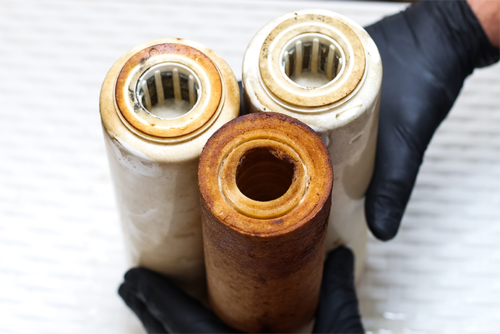 A filter blocks.
The first reaction is often:
"We need a higher micron rating."
But what if the filter isn't actually the problem?
A cartridge reaching high differential pressure unusually quickly could be telling you something about the process.
Before changing the filter, ask:
Has the incoming particle load changed?
A change in raw materials, water quality or upstream processing could increase the load reaching the filter.
Has the flow rate increased?
More flow can mean greater pressure drop and faster loading.
Has production changed?
A process that originally ran at one throughput may behave very differently after a capacity increase.
Is the prefiltration doing enough?
A final membrane or polishing filter shouldn't necessarily be expected to handle a particle load that could have been removed upstream.
Has the product changed?
Viscosity, solids concentration, formulation or temperature can all affect filtration performance.
Is the micron rating actually appropriate?
Going finer isn't automatically better. A smaller pore size can provide greater retention, but may also increase pressure drop or reduce service life.
This is where filtration becomes an engineering question.
Instead of:
"Which filter do you normally buy?"
Ask:
"What is happening before the filter?"
Pressure drop and flow data are increasingly being used to understand filter loading and support predictive maintenance approaches. Research and recent developments are looking at using these parameters to identify obstruction and estimate when a filter may require maintenance or replacement.
That doesn't mean every filtration system needs sophisticated monitoring.
Sometimes the answer is much simpler:
-
Look at the process.
-
Look at the filter history.
-
Look at the differential pressure.
-
Look at the flow rate.
-
Then change the specification.
- The best filter isn't always the finest filter.
It's the filter that performs reliably within the process it's actually being asked to handle?